Plaque vs. Tartar: Why Brushing Alone Can’t Remove Everything
Introduction
Slide your tongue along the back of your lower front teeth; if it encounters a rough, slightly raised ridge close to the gums, you have most likely discovered tartar, and no matter how thoroughly you scrub tonight, it won’t move it. Even though a great many people brush twice a day in a diligent manner, they are often surprised when the dentist spots hard deposits during a check-up. The reason for this is the difference between plaque and tartar: plaque is soft and can be removed at home, whereas tartar is hard and requires professional equipment. The following explains what each of these is, why your toothbrush is unable to remove tartar, and what you can do to prevent it from accumulating.
Table of Contents
- What Dental Plaque Really Is
- How Plaque Hardens Into Tartar
- Why Your Toothbrush Hits a Wall
- What Tartar Does When It Stays
- How Tartar Removal Works at the Clinic
- Keeping Plaque in Check Between Visits
- Conclusion
- Contact Us
What Dental Plaque Really Is
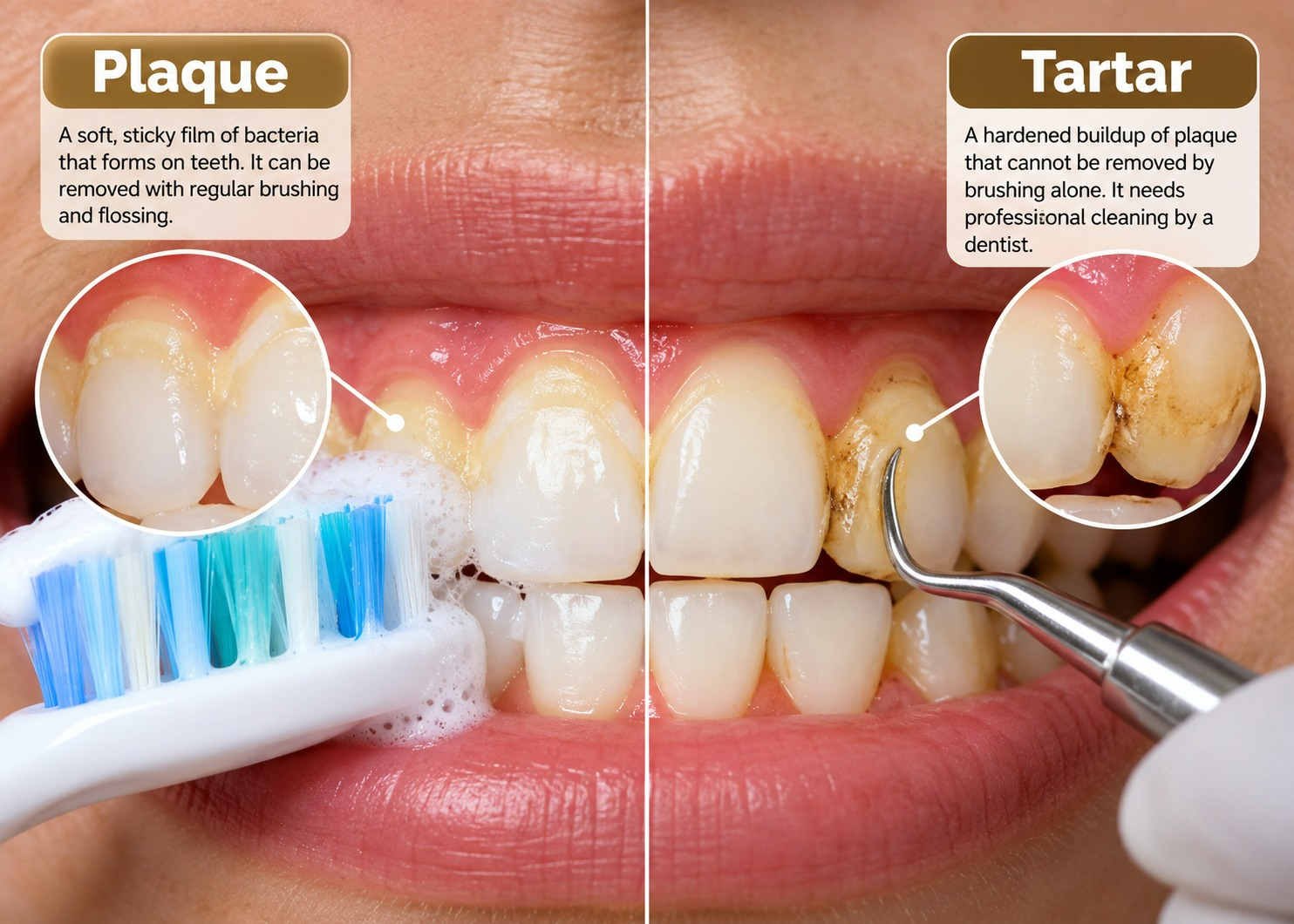
Dental plaque is a soft, sticky film made up of bacteria that stays on your teeth throughout the day. It is impossible to avoid entirely since it begins to form again within a few hours of brushing. It is generally pale or colourless, which is the reason why it is not noticed. The slightly fuzzy sensation you feel on your teeth when you first wake up is due to plaque.
The bacteria contained in plaque eat the sugars and starches that come from the food and drinks you take. When they break them down, they produce acids which damage the enamel and cause gum irritation. In fact, plaque is the first stage in the development of both cavities and gum disease.
The good news is that fresh plaque is soft and can be removed every day by thorough brushing and cleaning between the teeth.
If you want to see the plaque on your own, you can buy disclosing tablets from pharmacies. After brushing, chew one and any plaque that remains will turn pink or purple, thus showing you precisely where you’ve been missing.
How Plaque Hardens Into Tartar
Saliva contains minerals like calcium and phosphate; when plaque remains on a tooth for a sufficient length of time, these minerals deposit themselves in the plaque and cause it to harden, a process which can occur within a day or two; the hardened deposit is known as tartar or dental calculus.
Tartar forms in two places:
- Above the gumline (supragingival), it appears as a yellowish or cream-coloured crust, which tends to darken to brown after exposure to coffee, tea, smoking or shisha.
- Under the gum line (subgingival): it is located in the small space between the gum and the tooth, is usually darker in colour, and is difficult to spot without a dental examination.
People tend to develop tartar at different rates. This is due to factors such as saliva composition, diet, having a dry mouth, crowded teeth and the use of braces. Even two individuals who brush in the same way can end up with very different outcomes when they see the dentist.
Tartar is more likely to stain than enamel since its surface is porous and therefore the colour from drinks and tobacco is able to soak in; it is for this reason that yellow or brown lines often appear along the gums before any other symptom occurs.
Why Your Toothbrush Hits a Wall
When plaque has turned into tartar, it becomes firmly bonded to the tooth. A toothbrush can only remove the soft matter; it cannot break off the mineral deposits. Neither floss nor mouthwash nor whitening toothpaste is capable of getting rid of it. Once tartar has formed, professional teeth cleaning is the safe way to remove it.
Tartar also produces a rough surface, since fresh plaque finds it easier to stick to this rough surface than to smooth enamel and therefore tartar functions in a way like a magnet for additional bacteria; the cycle then continues itself.
Some areas collect tartar faster because of where your salivary glands release saliva:
- Behind the lower front teeth
- On the cheek side of the upper back molars
- Between teeth, where brush bristles struggle to reach
- Along the gumline, especially if you brush too quickly
Please resist the urge to scrape tartar off yourself with pins, blades or tools bought online. Home scraping can scratch enamel, cut the gums and push bacteria deeper under the gumline.
What Tartar Does When It Stays
Tartar on its own is not always painful, which is why people ignore it. But the bacteria living on and around it keep irritating the gums.
Gingivitis is the early stage. Gums look red or puffy and bleed when you brush or floss. At this point, a professional clean and better daily habits can usually reverse it.
Periodontitis is the later stage. The gum starts pulling away from the tooth, forming pockets where more tartar and bacteria collect. Over time, this can affect the bone that holds teeth in place, and teeth may begin to feel loose. Treatment at this stage aims to control the disease, and it often takes more than one visit.
Tartar can also contribute to persistent bad breath and visible staining, two things patients often notice before any discomfort.
How Tartar Removal Works at the Clinic
Tartar removal is done through a professional cleaning, often called scaling and polishing.
- Examination. The dentist or hygienist checks your teeth and gums and may measure the gum pockets around each tooth.
- Ultrasonic scaling. A fine instrument vibrates at high speed and uses a water spray to break tartar loose. You may feel vibration and hear a humming sound.
- Hand scaling. Small hand instruments remove the remaining deposits, especially in tight spots.
- Polishing. A gritty paste smooths the tooth surface so plaque has less to cling to.
- Advice. You get pointers on the areas you tend to miss.
For healthy gums, a standard cleaning is usually finished in one visit.
If tartar has gone below the gumline and pockets have formed, a deeper clean called root planing may be recommended. This smooths the root surface so the gum can heal against it, and local anaesthetic is used where needed for comfort. Deep cleaning teeth in this way may be spread over more than one appointment, depending on how many areas need treatment.
After a cleaning, some people notice mild gum tenderness, a little bleeding or temporary sensitivity to cold. This usually settles within a few days. Teeth often feel strangely smooth, and that is simply what a clean surface feels like.
Keeping Plaque in Check Between Visits
You cannot remove tartar at home, but you can slow down how quickly it forms.
- Brush twice a day for two minutes with a fluoride toothpaste. Angle the bristles toward the gumline.
- Clean between your teeth daily using floss or interdental brushes. This reaches the surfaces a brush misses.
- Consider an electric toothbrush. Many people find it easier to clean thoroughly, particularly around braces.
- Try a tartar-control toothpaste. It can slow new tartar from forming, though it does not dissolve existing deposits.
- Watch the all-day sipping. In Dubai offices, it is common to have karak, sweetened coffee or juice on the desk from morning to evening. Each sip feeds plaque bacteria. Having these drinks with a meal, then rinsing with water, gives your teeth a break.
- Drink water regularly. It helps wash away food particles and keeps the mouth from drying out, especially in the summer heat.
- Book regular professional cleanings. Your dentist will suggest a schedule based on how quickly you build tartar. You can ask about the dental cleaning price when booking, as it depends on the type of cleaning you need.
Conclusion
Plaque is soft, forms every day and can be removed with good brushing and cleaning between the teeth. Tartar is plaque that has hardened with minerals from your saliva, and once it sets, only a professional cleaning can remove it. Understanding plaque vs tartar makes it clear why daily care and regular dental visits work as a team. Keep up the brushing, give the gaps between your teeth some attention, and let your dentist handle what the toothbrush cannot.
Contact Us
Our JLT clinic is easy to get to if you would like your case to be assessed in person. If you would like to know the teeth cleaning price, our team can explain it after assessing your teeth and gums.
Magnum Dental Clinic – JLT
Address: Shop No. 2, Indigo Tower, Cluster D, Al Thanyah Fifth, Jumeirah Lakes Towers, Dubai, United Arab Emirates.
Phone: +971 54 452 2332