Why More GCC Families Are Choosing Leadership-Focused Business Education Over Traditional Degrees
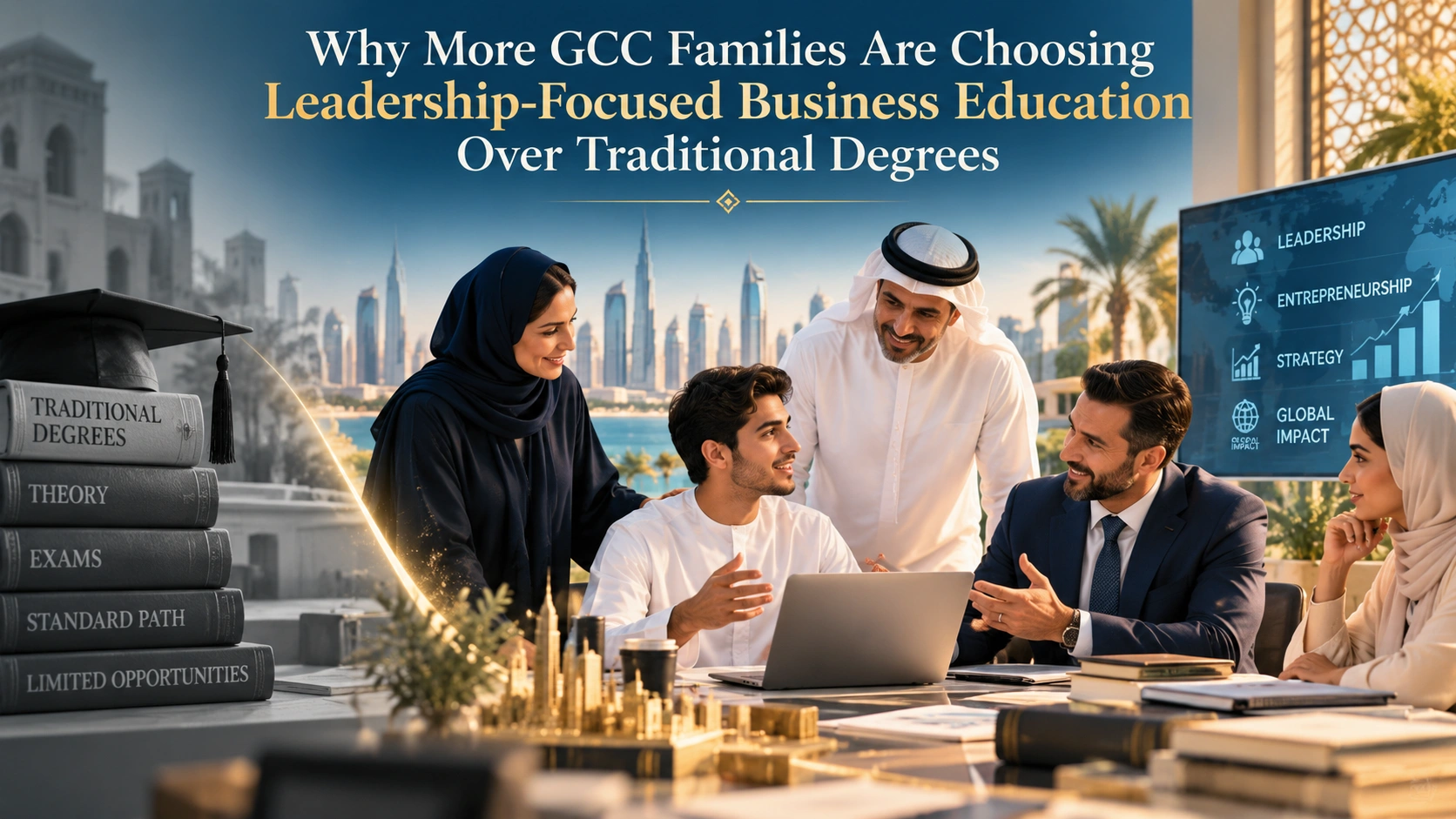
The traditional business degree has a well-established formula. Accounting, finance, marketing, operations — the functional disciplines taught in sequence, with the expectation that a graduate emerges equipped to step into an analyst role and build a career from there. For decades, this formula served its purpose well. It is increasingly being questioned by families across the GCC who are looking at what actually determines career success at the highest levels and concluding that functional expertise, while necessary, is no longer sufficient on its own. The leadership centers that Middle East institutions have built into their business programs reflect a broader shift in how business education is being reimagined — one that treats leadership not as an elective add-on but as a core discipline taught with the same rigor as finance or strategy.
What GCC Families Are Actually Observing
The shift toward leadership-focused business education in the GCC is not happening in the abstract. It reflects specific observations that families across the region — many of them expat families with international career mobility as a central consideration — are making about what actually predicts success in the careers their children are pursuing.
Something has shifted in what the GCC’s economic transformation actually rewards. Technical competence — once the clear differentiator — is now closer to a baseline expectation. Vision 2030 in Saudi Arabia, similar diversification strategies across the UAE, Qatar, and the broader region, and the speed at which new industries and sectors are emerging have produced a business environment where the fastest-advancing professionals are not the ones with the deepest technical grasp alone. They are the ones who can lead through ambiguity, manage relationships across cultures and hierarchies, and make calls in situations the textbook never anticipated.
Parents who have watched this dynamic play out in their own careers, or observed it in the careers of people around them, are drawing a specific conclusion: a business education that produces strong technicians but underdeveloped leaders is preparing graduates for the first five years of a career rather than the arc of an entire one.
Why Leadership Doesn’t Develop the Way Technical Skills Do
Understanding why leadership-focused education has become a distinct priority requires understanding something specific about how leadership capability actually develops — and why it doesn’t develop through the same mechanisms that produce technical competence.
Technical skills — financial modeling, statistical analysis, operational process design — are learnable through structured instruction, repetition, and testing. A well-designed curriculum can reliably produce competence in these areas because the skills themselves are relatively well-defined and the path to acquiring them is relatively linear.
Leadership doesn’t develop the way technical skills do. It requires practice in genuinely ambiguous situations. Exposure to different perspectives and different decision contexts. Structured reflection on one’s own patterns and blind spots. Feedback from people who watch the leader operate, not people grading a written exam. A business program that treats leadership as a single course — case studies, lectures, alongside the technical curriculum — isn’t providing that kind of developmental experience. It’s providing information about leadership. Those are not the same thing.
The leadership centers that the strongest business schools have built are specifically designed to address this gap. They provide structured leadership development through experiential learning, coaching, peer feedback, and sustained engagement with leadership challenges over the course of a degree program — rather than a single semester’s exposure to the topic.
The Cross-Cultural Dimension That Matters Specifically for GCC Families
For expat families in the GCC, there is a specific dimension of leadership education that carries particular weight: cross-cultural leadership capability. Students growing up in the GCC’s genuinely international environment — attending schools with classmates from dozens of nationalities, navigating multiple cultural contexts as a normal part of daily life — already carry cross-cultural fluency that many of their global peers lack.
The question for these families is whether the business education their children pursue builds on that existing cross-cultural capability or treats it as incidental. A leadership-focused program that specifically develops cross-cultural leadership skills — negotiating across cultural contexts, building trust with stakeholders from different backgrounds, adapting leadership style to different cultural expectations of authority and communication — takes the cross-cultural foundation these students already have and turns it into a genuine professional advantage.
This matters practically for career outcomes. Multinational corporations, international organizations, and businesses operating across the GCC’s genuinely global commercial environment are actively seeking leaders who can operate effectively across cultural contexts. Graduates who have deliberately developed this capability, rather than simply having grown up in a multicultural environment without formal development of the associated skills, enter the job market with a demonstrable and articulable advantage.
What a Leadership-Focused Business Education Actually Looks Like in Practice
For parents evaluating business school options, understanding what genuinely leadership-focused education looks like in practice — as distinct from marketing language that uses the word “leadership” without substantive curricular commitment — is a useful evaluation framework.
Genuine leadership development doesn’t announce itself with a single course title. It shows up in whether students actually lead real teams through real ambiguity — via simulations, live consulting projects, leadership challenges — rather than reading case studies about someone else’s decisions. It shows up in whether the coaching continues. Sustained. Personalised. Not a single assessment delivered once in year one and never revisited. And it shows up in whether leadership is threaded through the entire curriculum rather than boxed into one semester. An institution that gets all three right is treating leadership as core. One that gets none of them right is using the word as decoration.
Faculty and program leadership with genuine practical leadership experience — not just academic credentials in organizational behavior — also matters considerably. Leadership is taught more effectively by people who have led than by people who have only studied leadership from the outside.
What This Means for the Business Education Decision
For GCC families evaluating IE University and other business school options for their children, leadership development deserves the same scrutiny families have traditionally reserved for accreditation, career outcomes data, and the rigor of the technical curriculum. It isn’t a soft consideration sitting beside the hard metrics. It has become one of the hard metrics — one that predicts long-term career trajectory as reliably as the others.
The families making this shift are not abandoning the importance of technical business education. They are recognizing that technical competence and leadership capability are both necessary, and that a business education that develops only the former prepares graduates for a career ceiling that arrives sooner than families and students typically anticipate when the education decision is being made.