How to Read a Peptide Laboratory Report
Research-use-only notice: the materials discussed here are for in-vitro laboratory research only. They are not for human or veterinary use, and nothing in this article is medical advice.
Open a peptide laboratory report for the first time and it can feel like reading a foreign timetable. Task numbers, chromatograms, units you half remember from university. Yet most reports follow the same logic, and once you see it, you can scan one in a couple of minutes.
This guide goes through a typical report from top to bottom. It is written for laboratory staff, procurement teams, and researchers who buy research peptides Dubai suppliers list online and want to understand the documents attached to them.
Start With the Header, Not the Result
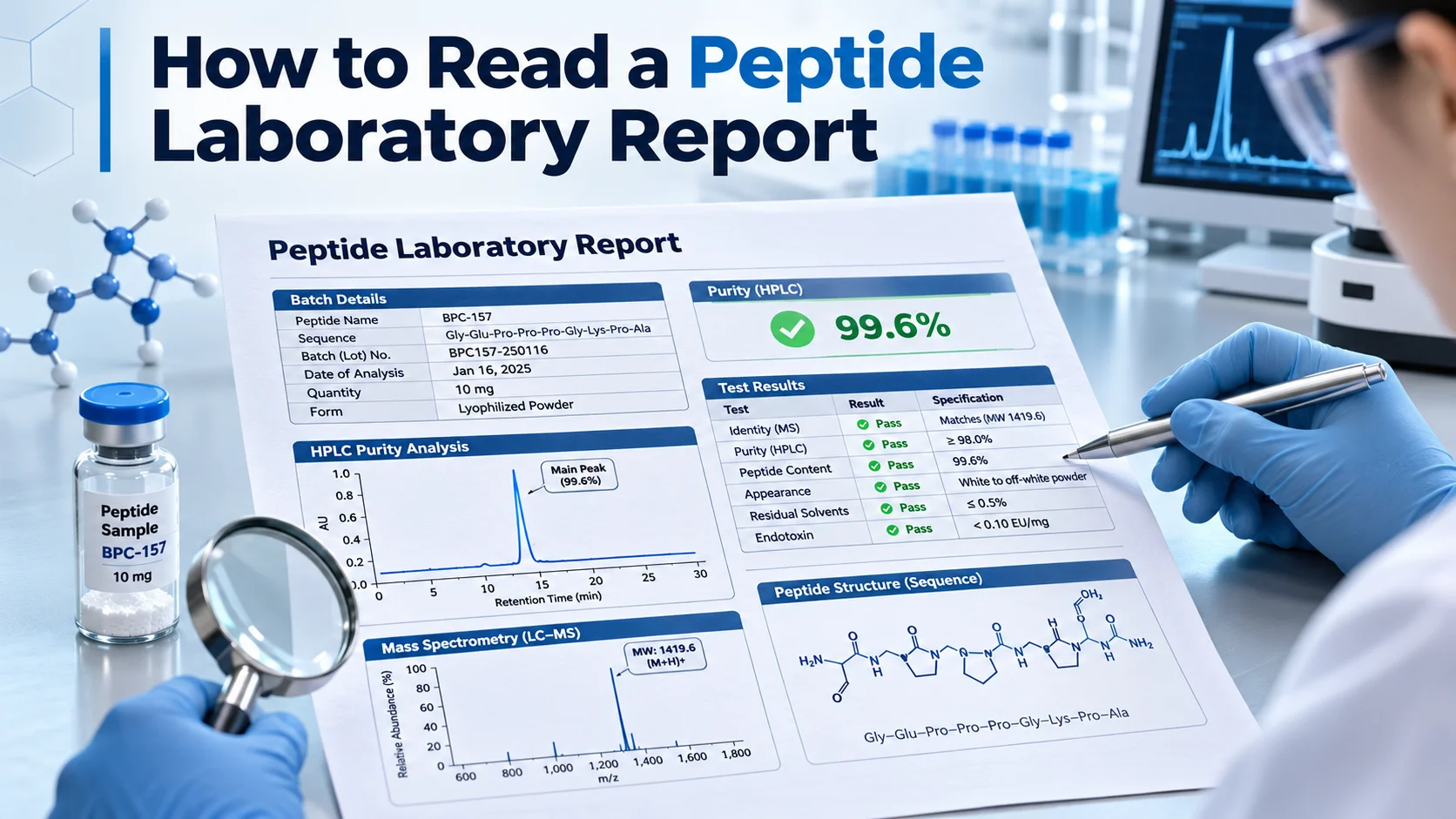
The top of a report is where traceability lives, so read it first. You are looking for:
- The laboratory name. Who produced the document, and are they independent of the seller?
- A task, report, or reference number. This is what you quote if you contact the laboratory.
- The sample description. Product name, format, and stated amount.
- The batch or lot identifier. It should match what you are ordering.
- Dates. When the sample arrived and when it was analysed.
If these fields are vague or missing, stop there. A result that cannot be tied to an identified sample is just a number.
The Chromatogram and the Purity Figure
The page most people jump to shows a graph with peaks. This is the output of HPLC, high-performance liquid chromatography. The instrument separates the components in a sample, and each one appears as a peak at a particular time.
The purity percentage is calculated from those peaks. In reversed-phase HPLC, the main peak’s area is compared with the total area of the peaks detected, so the figure describes how much of the detected peptide material is the intended peptide.
Two cautions keep the number in proportion. First, the figure depends on what the method can see. Some laboratories count only peptide peaks. One published report from Janoshik Analytical, for example, states that its purity assessment includes peptide peaks only. Second, a high percentage describes the sample’s peptide content. It does not tell you about water, salts, or anything the method did not detect.
Content, Amount, or Concentration
Next to purity you will often see a second figure, usually in milligrams for a vial or milligrams per millilitre for a liquid format. This is the measured amount or concentration of peptide in the tested sample.
It is worth comparing against the stated amount on the product. A report that gives purity but no content leaves a gap, because a sample can be pure and still contain less peptide than expected. Where a laboratory also runs an independent measure of amount, such as CHNS elemental analysis, that gives you a second angle on the same question.
The Extra Tests
Some reports stop at HPLC. Others add further analyses, each answering a separate question:
| Test | What it addresses |
| Endotoxin | Presence of bacterial endotoxins, reported in endotoxin units |
| Heavy metals | Arsenic, cadmium, lead, and mercury screening |
| Residual TFA | Trifluoroacetic acid left over from synthesis and purification |
| Microbial enumeration | Counts of aerobic bacteria, yeasts, and moulds (TAMC/TYMC) |
| CHNS | Elemental analysis, a second estimate of peptide amount |
| LCMS screening | Screening for contamination, using liquid chromatography with mass spectrometry |
A longer list does not automatically mean a better supplier, but it does mean more questions have been asked. When you compare two sets of peptide lab reports, compare the test lists first and the numbers second.
Identity Is a Separate Question
Purity and identity are different things. Purity says how much of the signal belongs to the main component. Identity says whether that component is the peptide you think it is, and it is normally answered with mass spectrometry, which compares measured and expected molecular weight.
Many reports do not include an identity test. That is not hidden misconduct, but it is a limit you should know about. If identity matters for your work, ask whether the laboratory ran it, or arrange your own confirmation.
Checking That the Report Is Real
Laboratories handle verification differently, and a good supplier explains how. Janoshik reports carry a task number and a verification key, which let you open the laboratory’s own copy and compare it with the one shown to you. METS Lab, in Ajman, UAE, issues reports with a report number and a signed PDF, and they have no online verification key. In that case, compare the batch number, sample description, and results against the PDF and write to the laboratory quoting the report number.
On its published page, Remy Research shows both routes alongside each batch, which is a useful model of how a supplier can make checking easier for the reader.
What the Report Does Not Say
Every report ends where its scope ends. Keep these limits in mind:
- It applies only to the identified sample or batch, not automatically to the lot that ships to you later.
- Purity testing does not establish sterility, and it does not establish safety for human use.
- A laboratory report is not a regulatory approval or proof of compliance with UAE requirements.
- Some reports carry a note that the laboratory could not confirm where the sample came from.
That last point matters. A report can be accurate about the sample it received and still say nothing about how that sample relates to your order.
A Quick Reading Routine
- Confirm the batch number and sample description.
- Note the laboratory, the report number, and the dates.
- Read the purity figure alongside the content figure.
- List the tests that were run, and the ones that were not.
- Check whether identity was tested.
- Verify the report using the laboratory’s own route.
- Read the limitations line.
Common Mistakes
Reading the percentage and nothing else. The number is one line of a longer document.
Skipping the dates. A report from long ago may not reflect the current batch.
Treating a missing test as a pass. Absence of a test means absence of information.
Comparing reports from different methods as if they were identical. Methods and reporting rules vary.
FAQs
What does HPLC purity mean on a peptide report?
It is the share of detected peptide material in the sample that is the intended peptide, calculated from the chromatogram.
Does a purity percentage confirm which peptide is in the vial?
Not on its own. Identity normally needs mass-spectrometry data.
Can a laboratory report show a peptide is safe?
No. Purity testing does not establish sterility or safety for human use, and these materials are for in-vitro laboratory research only.
What should I do if a report cannot be verified?
Ask the supplier for the laboratory’s verification route, and treat the report as unconfirmed until it checks out.
Conclusion
A peptide report rewards a slow read. Start with the header, weigh purity against content, note which tests are present and which are absent, and use the laboratory’s own route to confirm authenticity. Done in that order, the document tells you what was measured, on which sample, and where its evidence ends, which is exactly what a laboratory buyer needs to know.
These materials are supplied for in-vitro laboratory research only. Not for human or veterinary use.