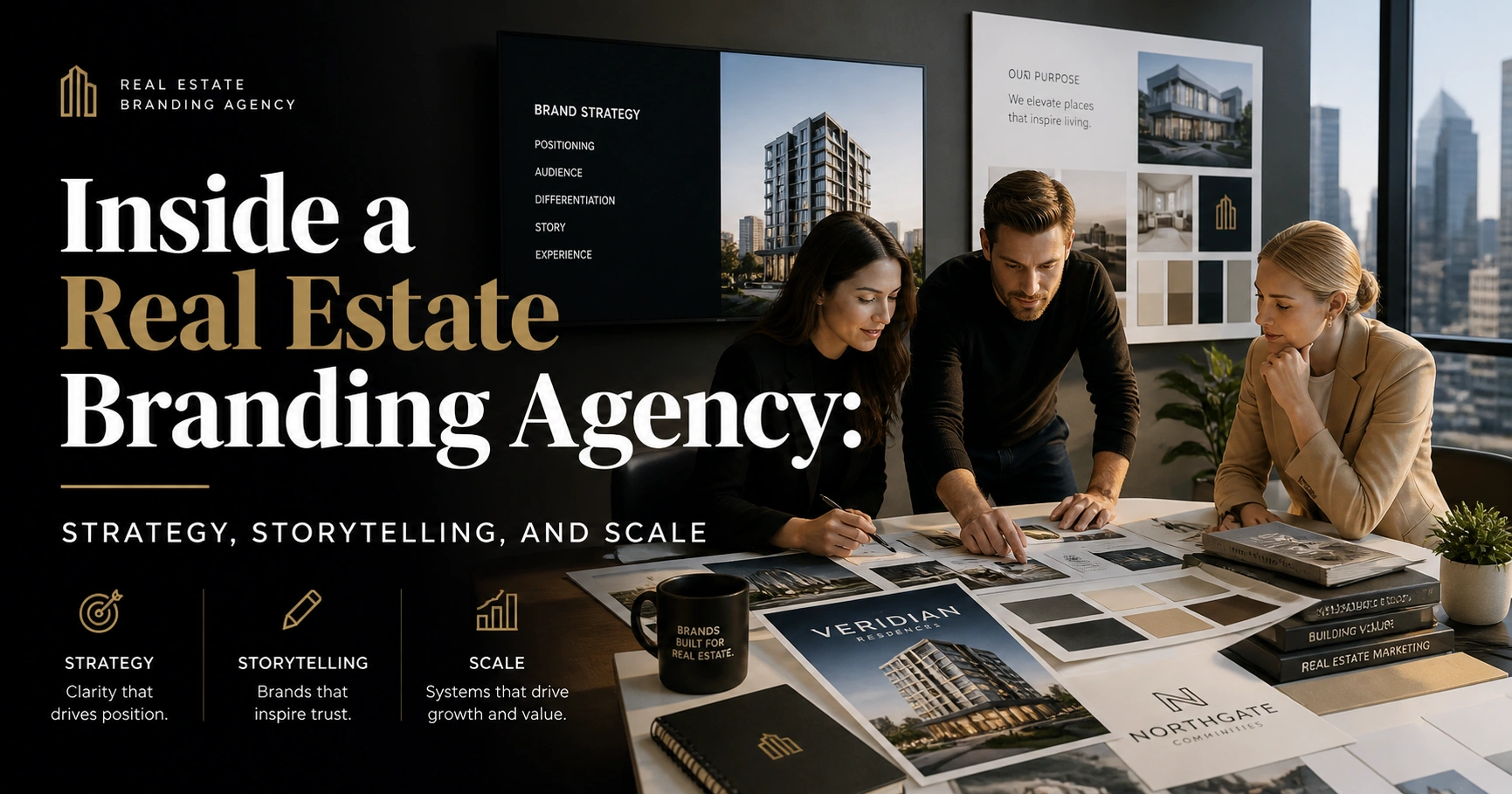
Inside a Real Estate Branding Agency: Strategy, Storytelling, and Scale
In the UAE real estate market, branding is no longer a surface-level exercise. It is not about logos, taglines, or short-term visibility. It is about how a project, a developer, or a brokerage earns trust at scale—across cycles, buyer segments, and market conditions. A real estate branding agency operating seriously in this region understands that its role sits much closer to business strategy than to traditional marketing execution.
After years of working alongside developers, brokers, and marketing heads across Dubai and the wider GCC, one truth has become clear: the most resilient real estate brands are built deliberately, long before the first campaign goes live.

Branding Begins Where Sales Cannot.
In mature property markets like the UAE, buyers arrive informed and cautious. They compare aggressively, research deeply, and carry memory—of delayed handovers, repositioned promises, and launches that faded quickly after hype. Very few decisions are made impulsively.
This is where real estate branding quietly does its most important work. Long before a broker speaks or a showroom visit happens, the brand has already framed expectations. It signals seriousness, stability, and intent. It answers unspoken questions around credibility, delivery capability, and long-term value.
A real estate branding agency working at a strategic level understands that branding reduces friction across the entire sales funnel—not through persuasion, but through reassurance. When a brand is clear, consistent, and familiar, buyers spend less energy questioning fundamentals and more energy evaluating fit.
Strategy Before Storytelling
Storytelling is often overused and underdefined in property marketing. In practice, it is not about emotional language or cinematic visuals. It is about coherence.
Effective real estate storytelling aligns four realities:
• The developer’s actual track record
• The project’s functional and financial intent
• The location’s lived truth, not its brochure version
• The buyer’s expectations, anxieties, and aspirations
Without this alignment, storytelling becomes decorative. It may attract attention, but it rarely sustains confidence.
A real estate branding agency must therefore start with a strategy. This means asking difficult questions internally before any creative direction is defined:
• What does this brand truly stand for in a crowded market?
• Where does it sit within the developer’s broader portfolio?
• Who is the core buyer and who is not?
• What should this brand represent five years from now, not just at launch?
When these questions are answered honestly, storytelling becomes less about invention and more about articulation. The narrative feels grounded, repeatable, and credible, qualities that matter deeply in high-value purchase decisions.
Scale Requires Systems, Not Campaigns
One of the most common challenges in real estate marketing is fragmentation. Each project is treated as a standalone event. New agencies, new visual styles, new narratives—often without regard for what came before.
Over time, this erodes brand equity. Buyers may recognise projects, but not the developer behind them. Brokers may sell units, but struggle to articulate a consistent brand story. Marketing teams stay busy, but disconnected.
Real estate branding at scale requires systems, not campaigns.
A capable real estate branding agency builds frameworks that allow brands to grow without losing identity. This includes:
• Clear brand architecture across projects and sub-brands
• Consistent messaging hierarchies that adapt to different buyer segments
• Visual systems that evolve without resetting recognition
• Narrative structures that sales teams and brokers can actually use
The objective is not uniformity, but continuity. Each launch should strengthen the brand, not restart it.
The Role of Timing and Market Sensitivity
The UAE property market is defined by speed, visibility, and sentiment. Market cycles are shorter. External influences like interest rates, visa reforms, and geopolitical shifts are felt quickly. Buyers respond not just to projects, but to timing.
A real estate branding agency operating in this environment must be highly attuned to the market mood. There are moments when aspiration works. There are others when reassurance matters more. Overconfidence during uncertain periods can damage trust just as much as under-communication during strong markets.
Brand strategy must therefore remain dynamic without becoming reactive. This balance comes from experience, having seen launches delayed, narratives adjusted, and positioning refined mid-cycle to protect long-term credibility.
Understanding Buyer Psychology at Different Price Points
One mistake often made in real estate branding is assuming that higher prices require louder branding. As a matter of fact, the opposite is true most of the time.
As ticket sizes increase, buyers look for restraint, clarity, and substance. They evaluate developer behaviour as much as product features. Consistency across communication channels becomes a proxy for operational discipline.
A real estate branding agency working at this level understands that branding must reflect buyer psychology at each tier. What reassures an end-user may not satisfy an investor. What excites a first-time buyer might feel excessive to an institutional stakeholder.
Strong branding adapts tone without diluting identity.
Branding as an Internal Alignment Tool
Branding is often viewed as an external-facing function. In practice, its internal impact might be just as significant.
A clear brand strategy aligns leadership, sales teams, brokers, and partners around a shared understanding of value. It lessens conflicting messages, short-term improvisation, and internal confusion during high-pressure sales phases.
A real estate branding agency that works closely with leadership teams recognises this role. Branding becomes a decision filter—guiding how projects are named, priced, positioned, and even phased.
When branding is integrated early, it prevents downstream inefficiencies that no amount of media spend can fix.
Branding Is a Leadership Decision
Ultimately, branding reflects leadership intent. It signals whether a developer or brokerage is building for transactions or for longevity.
Treat branding tactically, and it remains reactive. Treat it strategically, and it becomes an asset that compounds trust across projects, cycles, and markets.
This is where the role of a real estate branding agency shifts from execution to partnership. Not every organisation needs this at every stage. But when growth, reputation, and scale intersect, the value of a thinking partner becomes evident.
Agencies like Mint & Co. work in this sphere and approach branding of real estate as a long-term system rather than a sequence of campaigns. In such collaborations, branding is less about creative output and more about decision clarity.
In a market as competitive and visible as the UAE, that clarity often becomes the quiet advantage that separates enduring brands from momentary names.