
The Shade Guide Conversation: Why Choosing the Right White for Hollywood Smile Veneers Matters More Than You Think
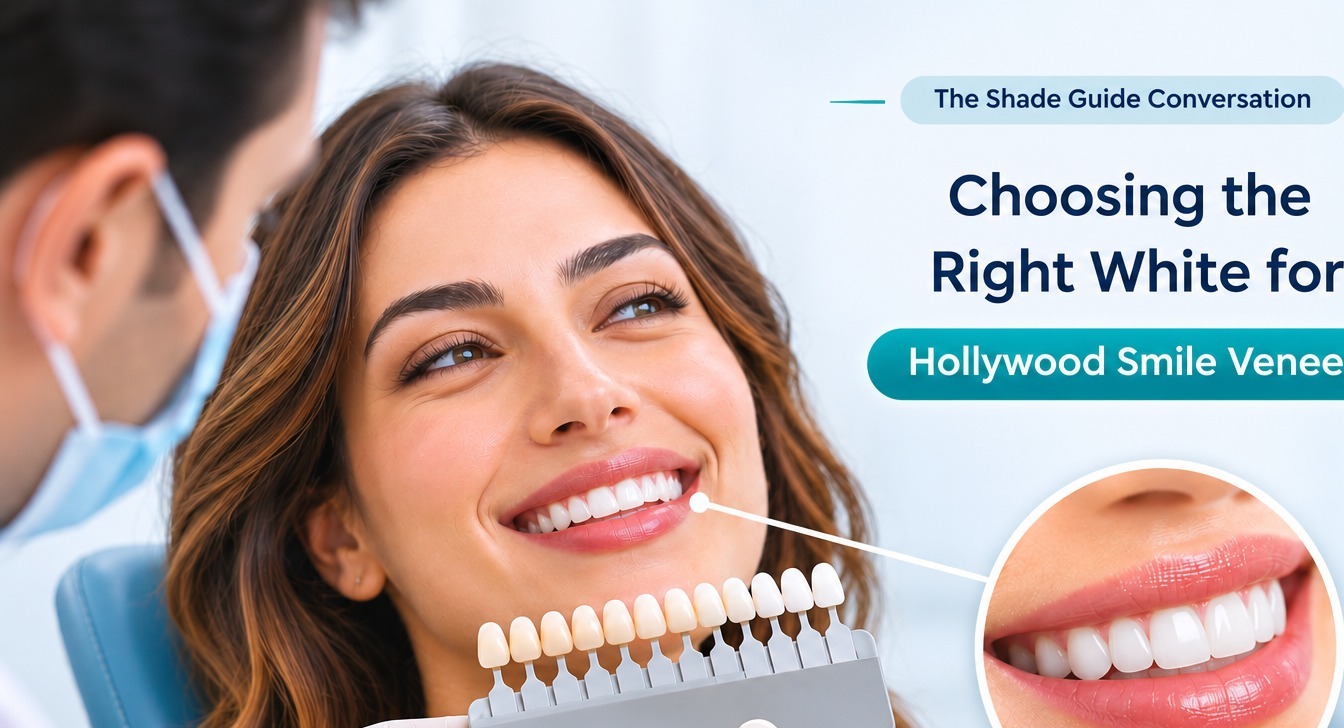
Table of Contents
- The Shade Is Not a Small Detail
- How Veneer Shades Are Measured
- Why “The Whitest” Is Rarely the Right Choice
- Skin Tone, Lip Colour, and the Role of Contrast
- Natural Teeth Have Layers of Colour
- What Happens When You Pick the Wrong Shade
- The Conversation You Should Have With Your Dentist
- Lighting, Photos, and Real-Life Testing
- Conclusion
- Contact Us
The Shade Is Not a Small Detail
When patients come in asking for a Hollywood smile, the first thing most of them want to talk about is how white they want their teeth. And that makes sense. A more shining smile is usually the whole point. But the specific shade of white you choose is one of the most consequential decisions in the entire process, and it rarely gets the attention it deserves.
Hollywood smile veneers sit on your teeth for the next decade or more. The shade you choose today will be the shade you see every morning in the mirror, under office lighting, in selfies, and in sunlight. Getting it wrong does not just look off. It can make the entire set of veneers look artificial, age you visually, or clash with your face in ways that are hard to articulate but easy to notice.
How Veneer Shades Are Measured
Dental shade guides organise tooth colours on a spectrum from very light to dark, and from warm (yellowish) to cool (greyish). The most commonly used system is the Vita Classical Shade Guide, which divides shades into four groups: A (reddish-brown), B (reddish-yellow), C (grey), and D (reddish-grey). Each group has numbered shades from lighter to darker.
For Hollywood smile veneers, most patients gravitate toward the lightest shades: B1, BL1, BL2, or BL3 on the Bleach shade extension. These are the ultra-white options you see on celebrities and influencers.
But a shade guide is simply about picking the lightest tab. It is about finding the shade that works with your specific combination of skin tone, eye colour, and the natural colour of your lower teeth (if only the upper arch is being treated).
Why “The Whitest” Is Rarely the Right Choice
BL1, the lightest shade available, is strikingly bright. On certain patients, it looks clean and polished. On others, it looks like a row of porcelain tiles. The difference usually comes down to contrast.
If your skin has warm, golden undertones, an ultra-cool, bright white shade can create a strong contrast that makes the veneers look fake. The eye picks up on this immediately, even if you cannot explain why. People see the teeth before they see the smile, and that is the opposite of what a Hollywood smile should do.
A slightly warmer shade, like B1 or BL2, often reads as naturally bright without crossing into artificial territory. Your dentist can hold the shade tabs against your face in different illumination to show you what this difference looks like in practice.
Skin Tone, Lip Colour, and the Role of Contrast
Your teeth do not exist in isolation. They sit inside your face, surrounded by your lips, framed by your skin. Shade selection needs to account for all of that.
Patients with deeper skin tones can often carry brighter shades comfortably because the contrast is naturally higher. Patients with lighter or medium skin tones sometimes look better with a slightly dialled-back shade that does not overpower their features.
Lip colour and thickness also matter. Fuller lips frame the teeth more prominently, which means the shade is more visible and any mismatch becomes more obvious.
These are not rigid rules. They are guidelines your dentist should walk you through during the shade selection appointment.
Natural Teeth Have Layers of Colour
One reason Hollywood smile veneers sometimes look fake has nothing to do with being extremely white. It is because they look flat. Natural teeth are not one solid colour. They are translucent at the edges, slightly more opaque in the middle, and have slight gradations from the gum line to the tip.
High-quality porcelain veneers replicate this layered effect. The ceramist at the dental lab builds up the veneer in multiple layers of porcelain with slightly different opacities and tints. The result is a veneer that catches and reflects light the way a real tooth does.
Cheaper or rushed lab work often produces a single-shade, opaque veneer that looks like a block of white. It may photograph fine under ring lights, but in natural daylight, it does not have the depth that makes teeth look real.
When discussing Hollywood smile veneers with your dentist, ask whether the lab provides layered or monolithic veneers. The difference in realism is significant.
What Happens When You Pick the Wrong Shade
A shade that is too white or too uniform can produce several issues:
- The “too perfect” look. When every tooth is identically white and identically shaped, the result can look more like a dental display model than a human smile.
- Mismatch with lower teeth. If you only treat the upper arch and your lower teeth are several shades darker, the gap between the two is immediately noticeable every time you open your mouth.
- Regret and redo costs. Replacing veneers because you are unhappy with the shade means re-preparing the teeth, new lab costs, and additional clinic time. It is expensive and avoidable.
Taking extra time at the shade selection stage is one of the simplest ways to prevent dissatisfaction later.
The Conversation You Should Have With Your Dentist
Before your Hollywood smile veneers are fabricated, ask these questions:
- Can I see the shade tabs held against my face, not just against my teeth?
- What shade do you recommend based on my skin tone along with facial features?
- Are you treating both arches, or just the upper? If only the upper, how will we match the lower teeth?
- Does the lab produce layered veneers, or are they monolithic?
- Can I see photos of previous patients who chose this shade?
A dentist who takes shade selection seriously will welcome these questions. This is not a five-minute decision. It is the difference between a Hollywood smile that looks natural and one that looks like it was installed.
Lighting, Photos, and Real-Life Testing
Shade matching should not happen under a single overhead light. Distinct lighting conditions reveal different aspects of a shade. Clinic lighting tends to be bright and neutral, which can make veneers look lighter than they will appear outdoors.
Some dentists take shade photos under natural light near a window, under incandescent light, and under fluorescent light to show you how the chosen shade will look in real-life conditions. Digital shade-matching devices can also provide objective measurements, removing some of the guesswork.
If your clinic does not offer this level of shade evaluation, ask for it. You will be living with this shade for years. It is worth spending an extra 20 minutes to get it right.
Conclusion
Shade selection is one of the most underrated steps in getting Hollywood smile veneers. The whitest option is not always the right one, and the difference between a natural-looking result and an obviously artificial one often comes down to this single conversation. Ask the right questions, test in different light, and trust a dentist who takes the time to guide you rather than simply handing you the lightest shade tab and moving on.
Contact Us
For residents of Arjan and nearby areas who are considering Hollywood smile veneers and want a thoughtful, detailed consultation, we are happy to welcome you.
Magnum Dental Clinic – Arjan
Building 88, Al Barsha South, Near Miracle Garden, Arjan, Dubai, United Arab Emirates
Phone: +971 55 890 8653


