A Parent’s Guide to Root Canal Treatment: When Your Child Needs Specialist Care to Save a Tooth
Introduction
Sometimes it’s just a tiny thing. The child will be chewing on one side only, will push a cold drink away (something they normally love), or will wake up at night saying their cheek is hurting. Kids aren’t always good at describing toothache so the parent will often be the first to pick up on the behaviour.
When a dentist talks about root canal treatment for a child, most parents are rather taken aback. Isn’t that something that only adults have? The fact is that children’s teeth can absolutely require endodontic treatment and in many cases it’s a way of saving a tooth that would otherwise have to be extracted. This guide looks at why it’s important to save a child’s tooth, what the signs are, what the treatment actually involves and how you can help your child through it.
Table of Contents
- Why Saving a Baby Tooth Matters
- Signs Your Child May Need a Dental Check
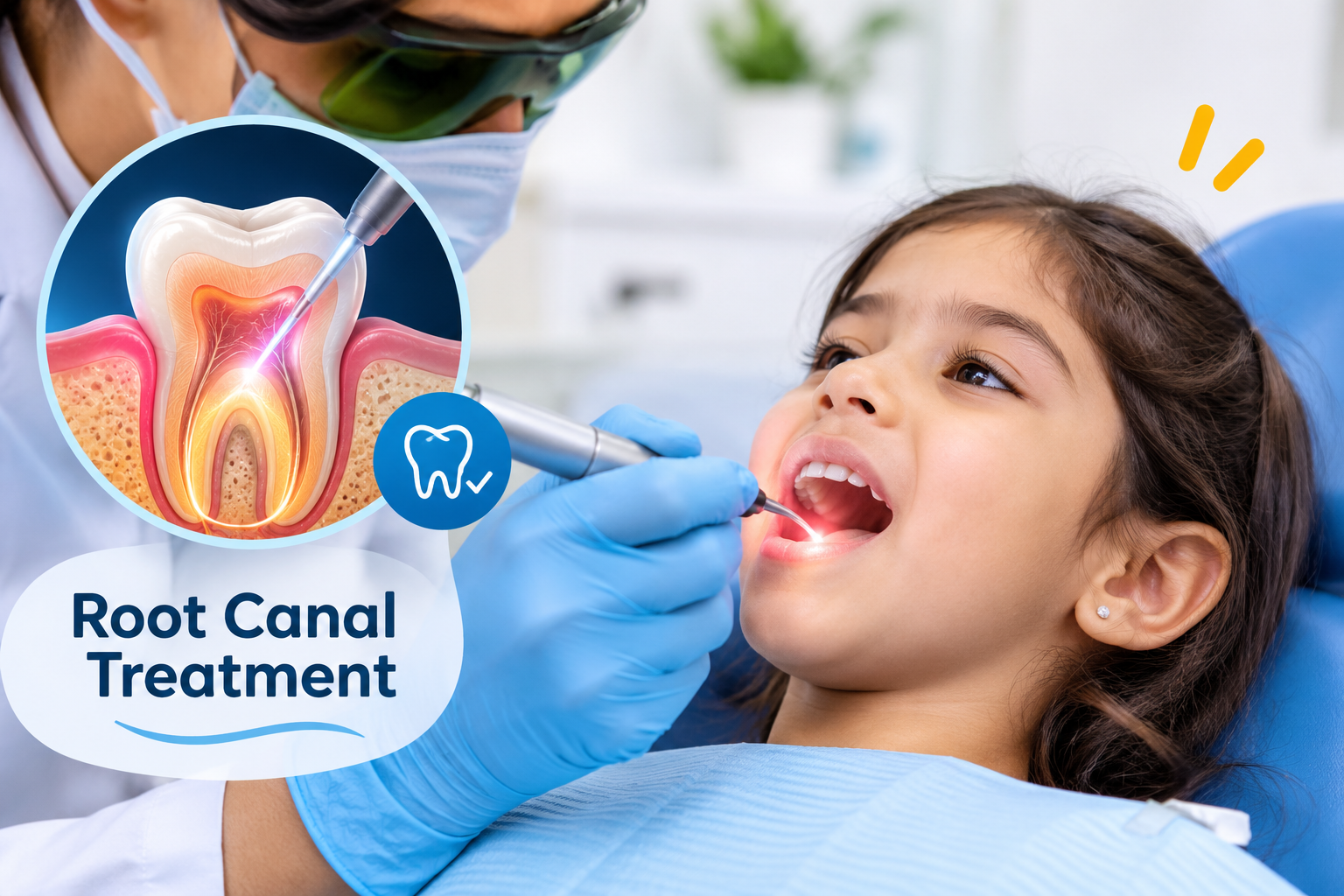
- What Root Canal Treatment Looks Like in Children
- Helping Your Child Feel Ready
- Aftercare at Home
- Preventing the Next Problem
- Conclusion
- Contact Us
Why Saving a Baby Tooth Matters
“It’s going to fall out anyway” is something you hear all the time from the dentist. Some of the primary teeth, particularly the back molars, will actually remain in the mouth until well into your child’s teens (up to 10/12 years of age). During that time they will be used for chewing, for clear speech and for holding space for the permanent tooth that’s growing in underneath.
If a baby molar is lost early the teeth adjacent to it will drift into the space and the adult tooth may come in crooked or get blocked and you may end up needing orthodontics. Your dentist may recommend a space maintainer if the tooth does need to be removed but in most cases it’s far simpler just to keep the natural tooth.
Signs Your Child May Need a Dental Check
- Toothache which wakes them up at night or which just comes on without any obvious trigger.
- Swelling of the gum or face in the area of a tooth.
- A small pimple-like bump on the gum (which can be an infection draining).
- Lingering sensitivity to hot or cold that persists once the hot/cold food or drink is gone.
- Darkening of a tooth (often weeks or months after the fall/knock).
- Deep visible cavities (brown or black holes in the back teeth).
- Refusing to chew on one side.
Facial inflammation with a fever requires urgent attention so get in touch with your dentist or go to the doctor on the same day. Infected teeth in children may not always be painful which is one of the reasons why it’s so important to have them checked regularly.
What Root Canal Treatment Looks Like in Children
The approach is going to be different depending on whether it’s a primary tooth or a permanent tooth and how much of the tooth is affected.
Pulpotomy. If the decay has got down to the nerve, but only the very apex of the pulp is involved, the dentist will remove that apex and place a medicated material over the sound pulp below. Very common in primary molars.
Pulpectomy (when the infection has got into the roots) involves the complete removal of the pulp. The canals are then cleaned and filled with a material which is appropriate for baby teeth, allowing the roots to simply resorb when the adult tooth is ready to erupt.
Treatment for a young adult tooth. An adult tooth which has just come through has roots that are still growing. If it’s decayed or injured the aim is often to protect the living pulp so that the root can continue to grow. These can be quite complicated cases and the child’s dentist may well involve an endodontist.
After root canal treatment a back baby tooth is usually capped with a little crown to protect it until it falls out naturally. As with any dental treatment there are limits to endodontic treatment in children. Some teeth are simply too badly broken or infected to save and in some cases a tooth that has been treated will require further treatment at a later date. Your dentist will go through these possibilities with you prior to commencing.
Helping Your Child Feel Ready
Kids pick up on how the adults around them feel. A few things tend to help:
- Keep the explanation simple. “The dentist is going to clean the sore bit of your tooth” is far better than a long winded description.
- Don’t use any scary words. Don’t use words like ‘needle’, ‘drill’ or ‘hurt’. Let the dental team do all the talking and use the kind of language that a child would understand.
- Book in a time that fits in with their routine. A morning slot or an appointment over the weekend (outside of the school week) is often a good one.
- Bring some comfort from home. A favourite toy or a familiar show in the waiting room can make a world of difference.
- Stay calm yourself, even if you’re feeling nervous on the inside.
On the day the tooth will be numbed with local anaesthetic and the dental team will go through each step with your child as they proceed.
Aftercare at Home
A bit of soreness for a day or two is perfectly normal and your dentist will have advice on appropriate pain relief for your child’s age. Numbness will probably last a few hours so be mindful that your child doesn’t bite or chew their lip, cheek or tongue in that time. Soft foods are the easiest for the rest of the day.
If the swelling gets worse, the pain gets worse rather than better or a crown or filling comes loose then get in touch with the clinic.
Preventing the Next Problem
Most tooth infections in children start caused by decay, and much of that can be prevented. Brushing twice a day using fluoride toothpaste, with an adult helping until the child can do it well, makes a real difference. Juice boxes, sweetened milk, and frequent snacking keep teeth under constant acid attack. In Dubai’s heat, water is the easiest drink to keep in your child’s school bag. Routine check-ups also let the dentist catch decay early, often while a simple filling is still enough.
Conclusion
A root canal on a child’s tooth is pretty much a bigger deal than it is in reality. In many instances it’s simply a way of allowing the primary tooth to remain in situ until the permanent tooth is ready to erupt. That in itself is of great benefit in terms of enabling normal chewing, speech and the correct spacing of the subsequent teeth. In the case of a young adult tooth it can actually be of benefit in allowing the root to continue to grow.
At Magnum Dental Clinic we have a paediatric dentist as well as a DHA licensed endodontist in the clinic for the more complex cases. If you’ve noticed any of the above signs then an early check-up will give you the clearest picture of what your child’s options are.
Contact Us
To arrange a check-up for your child, get in touch with our Arjan branch.
Magnum Dental Clinic, Arjan
Address: Building 88, Al Barsha South, Near Miracle Garden, Arjan, Dubai, United Arab Emirates
Phone: +971 55 890 8653