Laser-Assisted Root Canal Treatment: Is the Next Generation of Dental Care Worth It?
Introduction
Ask a dentist whether laser assisted root canal treatment is worth it and the honest answer is usually “it depends”. That’s not an evasion of the question at all. Lasers can be a useful adjunct to root canal treatment in certain circumstances but they don’t in any way replace the fundamental steps that are required to do a successful root canal and they aren’t the right tool for every tooth.
If you’ve come across laser treatment as part of your research prior to an appointment, this article sets out what the laser actually does, where it can be of help and where its limitations are, and what you should be asking yourself so that you can make a calm, informed decision.
Table of Contents
- How Conventional Root Canal Therapy Works
- Where the Laser Comes In
- Possible Benefits
- The Honest Limits
- Who May Benefit Most
- What the Appointment Is Like
- Questions to Ask at Your Consultation
- Conclusion
- Contact Us
How Conventional Root Canal Therapy Works
A quick refresher on the treatment itself. It’s all about removing the infected/inflamed pulp from inside the tooth, then cleaning, shaping and disinfecting the canals before sealing them. The cleaning is done with fine files and disinfecting rinses. The difficult bit is that root canals aren’t neat tubes at all. They branch, they curve and they have all sorts of little side channels that the files simply can’t get into. That’s why the rinsing is so important.
Where the Laser Comes In
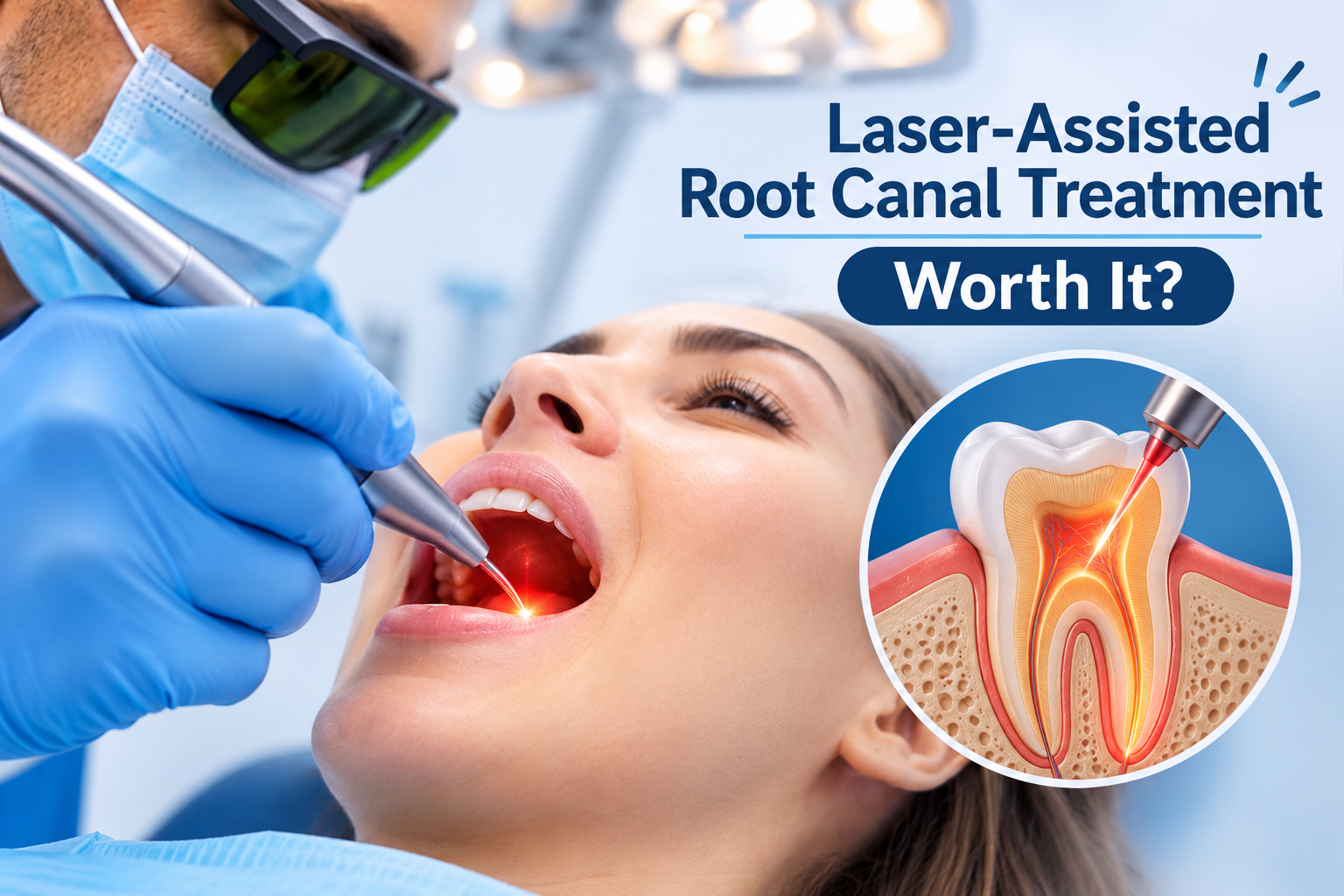
In laser assisted treatment the dentist still uses the files to shape the canals. The laser is used primarily in the cleaning and disinfection phase. The way in which the laser is used will depend on the type of laser and the technique being employed and it will be used in one of two broad ways:
- Direct disinfection (where you have a fine fibre in the canal and the laser energy is used to kill the bacteria on the canal walls).
- Activating the rinse where the laser creates a quick movement in the disinfectant liquid, pushing it into the small spaces and side branches that the files simply can’t get into.
Lasers are also used in other areas of dentistry (e.g. in the treatment of gum tissue). In root canal work their primary role is in assisting with disinfection.
Possible Benefits
- Better reach. Activated rinsing may help the disinfectant to get into areas of the canal system that are difficult to clean with files alone.
- Lower bacterial levels. Laboratory and clinical studies have reported lower levels of bacteria when the laser is used in conjunction with standard cleaning.
- Help with the tricky cases. Teeth with complex anatomy, or older root canals being redo’d, are the ones where extra disinfection is most often the thing we’re looking at.
The Honest Limits
This is where the ‘is it worth it’ question is actually answered. The research does support the use of lasers as an adjunct to cleaning, but the evidence that they lead to better long-term outcomes than properly performed conventional treatment is still very mixed. Long term success is really down to the fundamentals: finding all the canals, cleaning and shaping properly, sealing well and then putting on a good quality crown or filling.
Other points to weigh:
- Not every tooth needs it. A simple canal that can be cleaned adequately with conventional techniques is unlikely to benefit much from the use of a laser.
- Cost can vary. Extra equipment will have an impact on the price so get a full breakdown before you make up your mind.
- Recovery is much the same really. You’ll probably still be a bit tender for a few days as with any root canal treatment.
- Skill is of course the key. The laser has to be used at the correct settings and the clinician’s skill and experience is what makes the difference.
Who May Benefit Most
Your dentist may suggest laser assistance in situations like these:
- Complex anatomy, such as curved roots or several narrow canals
- Retreatment, where an older root canal has become reinfected
- Persistent infection that hasn’t settled after the first stage of cleaning
For a straightforward single canal front tooth, conventional treatment on its own is frequently all that is required.
What the Appointment Is Like
The visit follows the familiar pattern of root canal therapy. Your tooth is numbed with local anaesthesia, and a thin rubber sheet called a dental dam is placed around it to keep it clean and dry. Everyone in the room, including you, wears protective glasses while the laser is in use. Once cleaning is complete, the canals are filled and sealed, and the tooth is closed. Many cases take one or two visits, depending on the tooth and how much infection is present.
Questions to Ask at Your Consultation
- Why is it a laser for my tooth in particular?
- What would treatment be like without it?
- How many visits should I be expecting?
- Will it have any effect on the total cost?
- What imaging are you going to use to plan the treatment?
- Who is going to carry out the procedure and what is their licence title?
A good clinician will just answer that plainly and won’t pressure you one way or the other.
Conclusion
Laser assisted root canal treatment is a useful tool rather than a shortcut. Its real value is in its ability to help disinfect the hard to reach bits of a tooth and that can be the difference in a complex case or a retreatment. For a lot of straightforward teeth, conventional root canal treatment well done is quite good. The end game is the same in either case: get the infection out and keep your natural tooth.
So is it worth it? For some patients the answer is absolutely yes. For others it may be just as effective as conventional treatment. At Magnum Dental Clinic both laser dentistry and CBCT are available and a DHA licensed endodontist will assess your tooth and advise you on the best route to take.
Contact Us
If you’re in or near Jumeirah Village Circle and would like to go through your options, our JVC branch is right in the area.
Magnum Dental Clinic, JVC
Address: Arcadia Tower, Shop 2, Beside CART Supermarket, Jumeirah Village Circle, Dubai, United Arab Emirates
Phone: +971 50 719 3374