
Mole Mapping & Checking in Dubai: Why Regular Mole Checks Matter for Your Skin Health
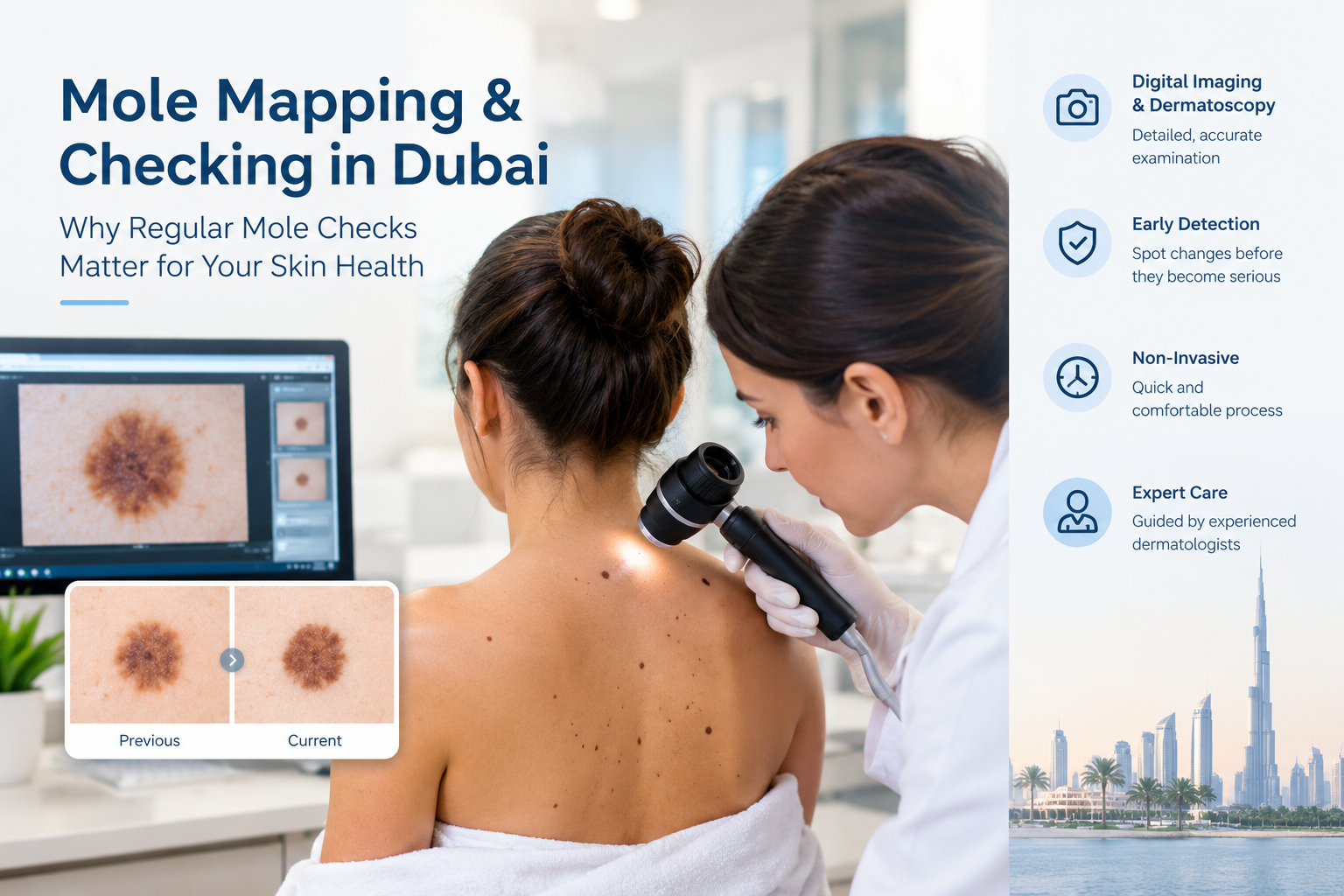
A mole may look like a small, harmless mark on your skin, but its appearance can sometimes change in ways that are difficult to notice without professional examination. A new mole, an alteration in an existing mole, or a spot that starts looking different from the others can deserve closer attention. This is where mole mapping and checking in Dubai can play an important role. Mole mapping combines a detailed skin examination with photographic documentation, allowing dermatologists to establish a baseline and monitor changes over time. According to an NHS dermatology information leaflet updated in 2026, mole mapping can involve whole-body photographs, close-up images of concerning moles, and comparison of images taken at different times to help identify changes.
At Athena Dermatology Clinic in Dubai, mole mapping and checking is offered using digital imaging and dermatoscopy to assess moles and track changes in their size, shape, and colour. The clinic describes its mole mapping assessment as a non-invasive process that can document moles across the body and help dermatologists identify lesions that may require closer examination. The important point is that mole mapping isn’t about assuming every unusual-looking mole is dangerous. Rather, it provides a structured way for a qualified dermatologist to examine your skin and compare what it looks like now with what it looked like previously.
What Is Mole Mapping and Checking?
Mole mapping is a method of documenting the moles and pigmented lesions on your skin so that they can be monitored over time. Instead of relying only on memory—”I think this mole looked smaller last year”—a dermatologist can use photographs and dermoscopic images as a visual reference. Whole-body photography can help identify the location of existing moles, while close-up images can provide greater detail for lesions that require monitoring. The images can then be reviewed at subsequent appointments to determine whether a mole has changed.
This is particularly useful because one of the important warning signs associated with melanoma is evolution, meaning a mole or pigmented lesion changes over time. The NHS states that a new mole or a change in an existing mole can be a sign of melanoma and recommends medical assessment for changes in size, shape, or colour, as well as symptoms such as itching, bleeding, inflammation, or crusting. A professional mole check therefore provides something that a quick glance in the mirror cannot: structured examination and clinical context.
How Digital Mole Mapping Works
During digital mole mapping, the dermatologist or trained clinical team captures images of relevant areas of the skin. Depending on the system and clinical requirements, this can include whole-body photographs and detailed dermoscopic images of individual moles. Dermoscopy allows trained healthcare professionals to examine pigmented lesions more closely than ordinary visual inspection. NICE guidance recommends dermoscopy by trained healthcare professionals when assessing pigmented skin lesions in relevant clinical settings.
At Athena Dermatology Clinic, the mole mapping process is described as involving a head-to-toe assessment using a dermatoscope, with high-definition photographs used to document moles and support future comparisons. The clinic states that the appointment typically takes around 30 minutes, although the duration can depend on the number of moles being examined. The real value is not simply taking a photograph; it is creating a useful clinical record that can support ongoing monitoring.
Why Mole Mapping Is Important for Early Detection
One of the biggest challenges with skin lesions is that changes can be subtle. A mole might gradually become darker, develop an uneven border, increase in size, or change in shape without causing pain. Because these changes may happen slowly, people can easily overlook them. A baseline image provides a reference point, making it easier for a dermatologist to identify differences during subsequent assessments.
Mole mapping can therefore become part of a long-term skin surveillance strategy, particularly for individuals who have numerous moles or other risk factors. An NHS dermatology service explains that cancerous moles can change over time and that mole mapping can assist in the early identification of skin cancer. At the same time, mole mapping should not be treated as an automatic diagnosis: the same NHS guidance emphasizes that a doctor still needs to review the images and decide whether further assessment is necessary.
Understanding Changes in Your Moles
Changes do not automatically mean that a mole is cancerous. Many unusual-looking skin lesions are harmless, and even features that appear concerning to a person without medical training may have a benign explanation. DermNet notes that the ABCDE characteristics can help identify lesions requiring attention, but they do not identify every early melanoma or atypical presentation, and not every lesion displaying these characteristics is melanoma.
That is why the goal of mole checking in Dubai should be professional assessment rather than self-diagnosis. If you notice something different, the sensible next step is to have it evaluated by a dermatologist. A specialist can examine the lesion using appropriate clinical techniques and determine whether monitoring, additional investigation, biopsy, or removal is appropriate.
Mole Mapping vs. a Traditional Mole Check
A traditional mole check generally involves a dermatologist examining your skin during a consultation. This remains an important part of evaluating suspicious lesions. Mole mapping adds another layer by creating photographic documentation that can be compared during future assessments. Think of it as the difference between looking at a photograph once and maintaining a visual timeline of how your skin has changed.
| Feature | Traditional Mole Check | Mole Mapping |
| Visual examination | Yes | Yes |
| Dermatologist assessment | Yes | Yes |
| Dermoscopy may be used | Yes | Yes |
| Whole-body photographic record | Not always | Commonly included |
| Comparison over time | More dependent on previous records | Central part of the process |
| Monitoring multiple moles | Possible | Particularly useful |
| Follow-up documentation | May vary | Designed for longitudinal monitoring |
Neither approach should be viewed as a replacement for the other. A dermatologist may use clinical examination, dermoscopy, photography, medical history, and follow-up together depending on the individual situation. NICE guidance specifically supports dermoscopic assessment and baseline photography for certain clinically atypical lesions that do not initially require excision.
Who Should Consider Mole Mapping in Dubai?
Mole mapping may be particularly useful for people who have many moles, atypical-looking moles, significant sun exposure, a history of sunburn, fair skin, or a personal or family history of skin cancer. Athena Dermatology Clinic identifies several of these factors when discussing people who may have a higher risk of melanoma.
Dubai’s outdoor lifestyle and strong sunlight also make sensible skin protection important. However, the decision to undergo mole mapping should be based on an individual’s skin characteristics, medical history, number and appearance of moles, and dermatologist’s advice rather than simply assuming that everyone requires the same monitoring schedule.
People With Higher Skin Cancer Risk
People with a personal or family history of skin cancer may require more structured surveillance. The same applies to individuals who have had substantial sun exposure or sunburns, used tanning beds, or have a large number of moles. Athena Dermatology specifically highlights fair skin, significant sun exposure or sunburn, tanning-bed use, and family history as factors associated with increased melanoma risk.
If you fall into one of these categories, a dermatologist can help determine whether mole mapping is appropriate and how frequently follow-up should occur. The schedule is not necessarily identical for everyone. One NHS mole-mapping service states that follow-up intervals can range from three months to yearly depending on the clinical situation.
The ABCDE Rule for Checking Moles
The ABCDE rule is a widely used framework for recognizing features that can warrant professional evaluation. It stands for Asymmetry, Border, Colour, Diameter, and Evolving. The American Academy of Dermatology describes asymmetry as one half of a spot looking different from the other, while concerning border characteristics can include irregular or poorly defined edges. Colour variation can also be a warning sign.
Diameter is another part of the checklist, with 6 mm often used as a reference point, although melanoma can be smaller when diagnosed early. The final and particularly important element is Evolving—a lesion that changes over time. The NHS similarly advises medical assessment for moles that change size, shape, or colour or become painful, itchy, inflamed, bleeding, or crusty.
When a Changing Mole Needs Medical Attention
You don’t need to wait until a mole satisfies every part of the ABCDE checklist before speaking with a dermatologist. A mole that has recently changed, a new unusual mark that persists, or a lesion that begins bleeding or becoming crusty deserves professional attention. Some melanomas may not display every classic ABCDE characteristic, which is one reason professional evaluation matters.
Self-checking can be useful between professional appointments, but it has limitations. You may struggle to see areas such as your back or scalp, and subtle dermoscopic features cannot be assessed accurately with an ordinary mirror. If you notice something unusual, arranging a mole check in Dubai with a qualified dermatologist can provide a more appropriate assessment.
What Happens During a Mole Mapping Appointment?
A mole mapping appointment generally begins with an assessment of your skin and discussion of relevant concerns or changes you’ve noticed. The dermatologist may ask about your medical history, previous skin problems, sun exposure, family history, and any particular mole that has recently changed. Photographs can then be taken to establish a baseline, with closer dermoscopic images used for selected lesions.
At Athena Dermatology Clinic, the described process includes a head-to-toe examination using dermoscopy and high-definition documentation of moles. The clinic states that suspicious lesions may require further examination, biopsy, or removal depending on the dermatologist’s assessment. This distinction is important: mole mapping is a monitoring and assessment tool, not itself a cancer diagnosis.
If a lesion requires further investigation, a dermatologist may recommend a biopsy. The NHS explains that when melanoma is suspected, a specialist may remove the mole and a small surrounding area so the tissue can be examined in a laboratory.
How Often Should You Have Your Moles Checked?
There isn’t one universal schedule that applies to everyone. The appropriate frequency depends on factors such as the number and type of moles you have, previous skin cancer, family history, sun exposure, and what your dermatologist observes during examination. Athena Dermatology notes that individuals at higher risk may require mole mapping every 6 to 12 months, while its guidance also recommends regular self-checking between professional assessments.
Clinical follow-up can be more frequent when a particular lesion requires closer observation. For example, NHS guidance notes that mole-mapping intervals can range from three months to one year depending on the clinical circumstances. Rather than choosing a schedule based on a generic internet recommendation, discuss your personal monitoring interval with a dermatologist.
What Happens If a Suspicious Mole Is Found?
Finding a suspicious mole does not automatically mean that you have skin cancer. The next step depends on what the dermatologist observes. Some lesions may simply need another photographic assessment after a suitable interval, while others may require an in-person review, biopsy, or removal.
When melanoma is suspected, tissue examination through biopsy can provide a definitive diagnosis. The NHS describes excision biopsy as a principal diagnostic test in which the mole and a small area of surrounding skin are removed and sent to a laboratory for examination. Athena Dermatology also explains that suspicious moles identified during its assessment may require biopsy or removal.
This is why timely evaluation matters. The purpose of mole mapping isn’t to create anxiety around every spot on your skin; it’s to create a systematic process for identifying changes that deserve professional attention.
Preparing for Your Mole Mapping Appointment
A little preparation can make the examination easier and improve the quality of photographic documentation. Athena Dermatology recommends avoiding excessive sun exposure before an appointment and avoiding lotions or oils on the day of the assessment. The clinic also advises patients to make a note of recent changes in their moles so they can discuss them with the dermatologist.
It is also useful to think about what you have noticed before arriving. Has one mole recently become darker? Has its shape changed? Did you notice bleeding or persistent itching? Do you have photographs from previous months that show the lesion? These details can help the dermatologist understand why you are concerned and decide whether a lesion requires additional assessment.
Choosing a Dermatologist for Mole Mapping in Dubai
When searching for mole mapping in Dubai, look beyond the phrase “advanced technology.” The quality of a mole assessment depends not only on imaging equipment but also on appropriate clinical examination and interpretation. NICE guidance emphasizes that dermoscopy of pigmented lesions should be performed by healthcare professionals trained in the technique.
Athena Dermatology Clinic provides clinical dermatology services in Dubai and lists Mole Mapping & Check among its clinical dermatology treatments. The clinic states that its dermatologists assess moles using digital dermatoscopy and provide recommendations when further investigation or treatment is needed.
Location and accessibility can also matter because mole monitoring may involve follow-up appointments. Athena Dermatology Clinic is located at The Onyx Tower 2, The Greens, Dubai, UAE, and provides mole mapping, mole removal, skin biopsies, and other dermatology services.
Mole Mapping and Long-Term Skin Monitoring
Think of mole mapping as creating a visual health record for your skin. A single examination tells a dermatologist what your skin looks like today. A series of appropriately timed assessments can provide information about how individual lesions behave over time. This can be especially useful when a mole does not initially require removal but needs observation.
The NHS describes mole mapping as a process where images can be repeated later and compared to identify changes. This longitudinal approach is one of the key reasons digital documentation can be useful in dermatology. It can turn a vague memory of “something looks different” into a more objective comparison for the dermatologist.
At home, regular skin awareness still matters. Check areas that are easy to see and use a mirror or ask someone you trust to help with areas that are difficult to inspect. If you identify a new or changing mole, don’t wait for your next routine mapping appointment—seek professional advice.
Conclusion
Mole mapping and checking in Dubai can provide a structured approach to monitoring moles and identifying changes that may need professional assessment. Digital photography, dermoscopy, and follow-up comparisons can give dermatologists more information than a single visual examination, particularly when multiple moles need to be monitored over time.
The most important takeaway is simple: don’t ignore a mole that is changing. A new mole, changing shape or colour, irregular borders, bleeding, itching, crusting, or other unusual developments should be discussed with a qualified dermatologist. The ABCDE rule can help you become more aware of changes, but it should not replace professional evaluation.
If you’re looking for mole mapping in Dubai, Athena Dermatology Clinic’s Mole Mapping & Check service provides dermatological assessment, digital imaging, and monitoring for changes in moles, with further investigation recommended when clinically appropriate.
FAQs About Mole Mapping and Checking
1. Is mole mapping painful?
Mole mapping is generally a non-invasive assessment involving skin examination, photography, and dermoscopy. The imaging process itself does not involve cutting or injections. If a dermatologist identifies a lesion that requires biopsy or removal, that is a separate procedure and will be discussed with you.
2. Can mole mapping diagnose melanoma?
Mole mapping helps document and monitor skin lesions, but it is not by itself a definitive diagnosis of melanoma. A dermatologist reviews the findings and may recommend additional assessment or biopsy when necessary. Tissue examination may be required when melanoma is suspected.
3. Who should consider mole mapping in Dubai?
People with numerous moles, atypical moles, significant sun exposure, previous sunburns, fair skin, or a personal or family history of skin cancer may benefit from discussing mole mapping with a dermatologist. The appropriate monitoring schedule should be determined based on individual risk factors.
4. What does the ABCDE rule mean?
ABCDE stands for Asymmetry, Border, Colour, Diameter, and Evolving. It is a useful awareness tool for identifying changes that may require professional evaluation. However, not every melanoma follows the classic ABCDE pattern, so unusual or changing lesions should still be assessed by a dermatologist.
5. Where can I get mole mapping in Dubai?
Athena Dermatology Clinic offers Mole Mapping & Check in Dubai, including digital imaging and dermatoscopy for assessing and monitoring moles. The clinic is located at The Onyx Tower 2 in The Greens, Dubai.


